Market Sentiment
Primary Assets Affected
Table of Contents
- SpaceX IPO at a Glance
- Why the SpaceX IPO Matters
- SpaceX by the Numbers
- Starlink Could Be the Real Growth Engine
- SpaceX and the Future of Artificial Intelligence
- Why Solana Is Also Part of the Story
- SpaceX vs Tesla: Which Company Has More Long-Term Potential?
- Risks Investors Should Consider
- Valuation Risk
- Starlink Dependency
- Government Exposure
- Competition
- Market Volatility
- What Traders Should Watch After the Opening Bell
- What the SpaceX IPO Means for the Future
- Final Thoughts
For years, SpaceX was considered one of the most valuable private companies in the world. Investors, analysts, and technology enthusiasts repeatedly asked the same question: when will SpaceX finally go public?
That moment has now arrived.
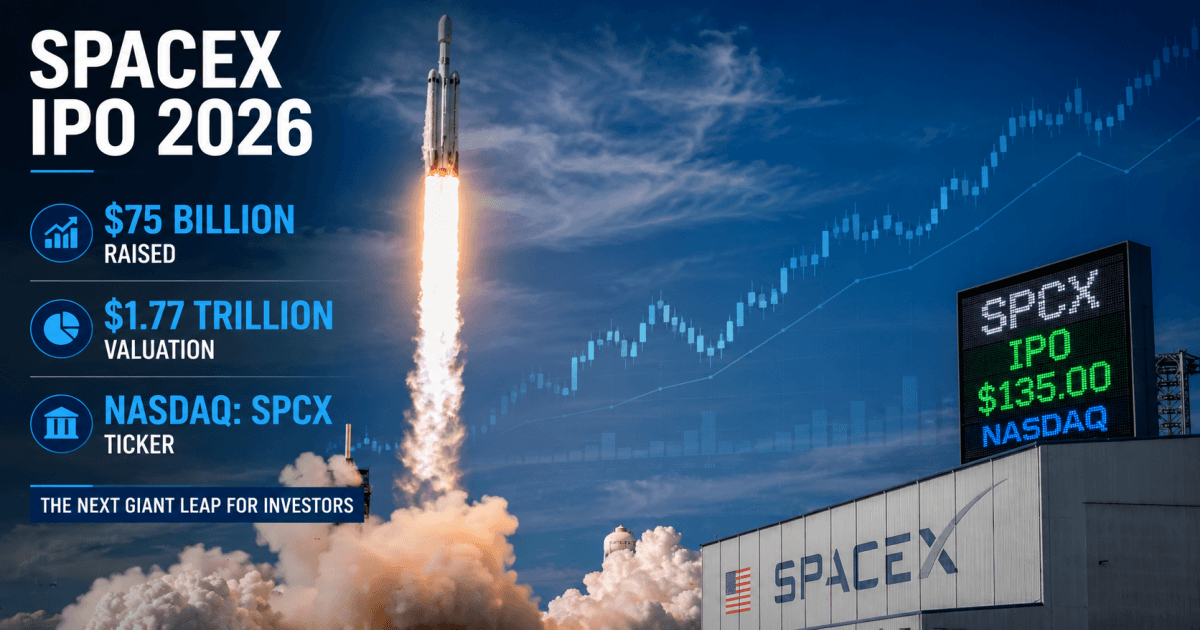
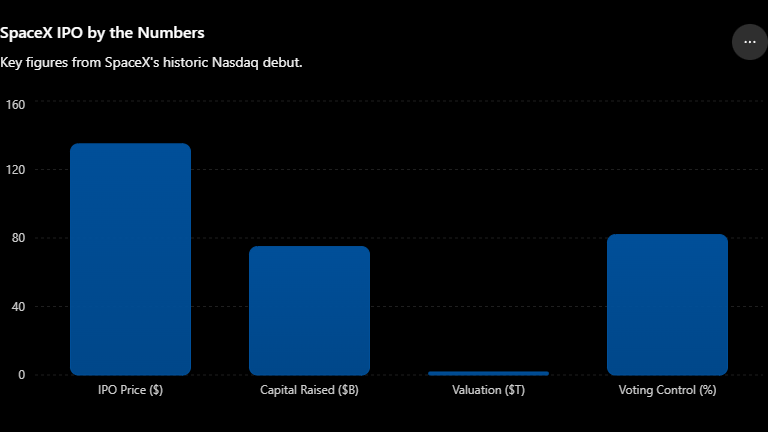
SpaceX has officially entered public markets in what is being described as one of the largest and most closely watched IPOs in financial history. With an IPO price of $135 per share, approximately $75 billion raised, and a valuation approaching $1.77 trillion, the company instantly joins the ranks of the world's most valuable publicly traded businesses.
Trading under the ticker SPCX on Nasdaq, SpaceX represents far more than a traditional aerospace company. Investors are gaining exposure to commercial space launches, satellite communications, global internet infrastructure, artificial intelligence initiatives, and one of the most ambitious long-term visions in modern business.
The SpaceX IPO is not simply a stock market event. It is a major milestone for the space economy, financial markets, and the future of technology.
SpaceX IPO at a Glance
| Metric | Value |
|---|---|
| Company | SpaceX |
| Ticker | SPCX |
| Exchange | Nasdaq |
| IPO Price | $135 |
| Capital Raised | $75 Billion |
| Valuation | $1.77 Trillion |
| Founder | Elon Musk |
| IPO Date | June 12, 2026 |
The scale of the IPO highlights investor demand for companies operating at the intersection of technology, communications, infrastructure, and innovation.
Many analysts believe this listing could become one of the most important public market debuts of the decade.
Why the SpaceX IPO Matters
SpaceX is not just another technology company entering public markets.
The company has fundamentally changed the economics of space launches through reusable rocket technology and has built one of the largest satellite communication networks in history through Starlink.
Unlike many high-growth companies that rely on a single product, SpaceX operates across several industries simultaneously:
-
Commercial launch services
-
Satellite internet
-
Defense and government contracts
-
Telecommunications infrastructure
-
Artificial intelligence initiatives
-
Future space transportation systems
This diversification is one of the main reasons investors have shown such strong interest in the IPO.
Many view SpaceX not as an aerospace company, but as a global infrastructure business with exposure to some of the fastest-growing sectors in the world.
SpaceX by the Numbers
The valuation assigned to SpaceX immediately places the company among the world's corporate giants.
To understand the scale of the business, investors need to look beyond rockets.
SpaceX has spent years building a network of assets that would be extremely difficult for competitors to replicate.
These include:
-
Thousands of operational satellites
-
Global launch infrastructure
-
Long-term government contracts
-
Proprietary launch technology
-
Starlink's communications network
-
Advanced aerospace engineering capabilities
Supporters of the valuation argue that few companies possess such a unique combination of physical infrastructure, technological leadership, and future growth potential.
Critics, however, point out that a valuation approaching $1.77 trillion assumes years of continued execution and rapid expansion.
As with any major IPO, expectations are extremely high.
Starlink Could Be the Real Growth Engine
While rockets generate headlines, Starlink may ultimately prove to be the most valuable asset within the SpaceX ecosystem.
Starlink has expanded rapidly across global markets and provides internet access in regions where traditional broadband infrastructure is limited or unavailable.
For investors, this changes the entire investment thesis.
Instead of viewing SpaceX as a launch company, many see it as a communications and infrastructure business.
Starlink's potential revenue opportunities include:
-
Residential internet services
-
Enterprise connectivity
-
Maritime communications
-
Aviation internet services
-
Government contracts
-
Emergency communications
-
Direct-to-device mobile connectivity
The long-term opportunity is enormous.
As internet connectivity becomes increasingly essential worldwide, satellite-based solutions may play a much larger role in the global communications market.
Many investors believe Starlink could eventually become one of the largest satellite communications businesses ever created.
SpaceX and the Future of Artificial Intelligence
Another important aspect of the SpaceX story is its connection to artificial intelligence.
Across Elon Musk's companies, AI has become a central strategic focus.
The combination of satellite infrastructure, data transmission, cloud computing, communications networks, and AI systems creates opportunities that extend far beyond aerospace.
This broader ecosystem is becoming increasingly interconnected.
Investors interested in Musk's expanding AI ambitions may also find this related analysis useful:
Related Reading:
https://www.fxradar.live/market-news/nvidia-investment-in-xai-elon-musks-latest-ai-funding-breakt.html
As AI adoption accelerates globally, infrastructure providers capable of supporting large-scale computing and communications networks could become significant beneficiaries.
This is one reason many investors see SpaceX as more than a traditional aerospace company.
Why Solana Is Also Part of the Story
One of the most interesting developments surrounding the IPO comes from the digital asset industry.
Alongside the traditional Nasdaq listing, tokenized versions of SpaceX shares are expected to become available through blockchain infrastructure built on Solana.
This development highlights a growing trend known as tokenized securities.
The goal is to connect traditional financial assets with blockchain technology, potentially improving accessibility, transparency, and settlement efficiency.
While the market for tokenized securities remains in its early stages, the involvement of a company as prominent as SpaceX has attracted significant attention from both crypto investors and traditional market participants.
The SpaceX IPO may therefore represent an important moment not only for equities but also for the future of digital finance.
SpaceX vs Tesla: Which Company Has More Long-Term Potential?
For more than a decade, Tesla has been the company most closely associated with Elon Musk.
Today, however, many investors believe SpaceX could eventually become the most valuable company in Musk's portfolio.
Tesla transformed the automotive industry and accelerated the global adoption of electric vehicles.
SpaceX is attempting something equally ambitious.
The company is building infrastructure that supports communications, transportation, defense systems, and potentially future economic activity beyond Earth.
The comparison is fascinating because both companies address massive markets but in very different ways.
Tesla focuses on vehicles, energy storage, robotics, and AI.
SpaceX focuses on space transportation, communications infrastructure, satellite internet, and aerospace technology.
The IPO now allows public market investors to directly compare how Wall Street values these different visions of the future.
Risks Investors Should Consider
Despite the excitement, SpaceX is not without risks.
Every major investment opportunity comes with uncertainty.
Valuation Risk
A valuation approaching $1.77 trillion leaves little room for disappointment.
Investors are pricing in significant future growth and continued market leadership.
Starlink Dependency
A large portion of investor optimism depends on Starlink's continued expansion.
Any slowdown in subscriber growth could affect future expectations.
Government Exposure
SpaceX benefits from substantial government and defense-related contracts.
Changes in policy, regulations, or government spending priorities could influence future revenue.
Competition
Although SpaceX currently maintains a dominant position, competition continues to emerge across both aerospace and satellite communications industries.
Market Volatility
High-profile IPOs often experience substantial price swings during their first weeks and months of trading.
Short-term volatility should not be surprising.
What Traders Should Watch After the Opening Bell
The first trading session is likely to attract significant global attention.
Several factors will be closely monitored:
-
Opening price relative to the IPO price
-
Trading volume
-
Institutional participation
-
Retail investor demand
-
Market reaction across technology stocks
-
Performance of aerospace companies
-
Activity surrounding tokenized SpaceX shares
-
Impact on broader risk sentiment
The first few days of trading may provide valuable insight into how investors view SpaceX's long-term prospects.
What the SpaceX IPO Means for the Future
The SpaceX IPO arrives during a period of rapid technological change.
Artificial intelligence, satellite communications, digital finance, and space technology are all evolving simultaneously.
SpaceX sits at the center of many of these developments.
Few companies have meaningful exposure to:
-
Space exploration
-
Satellite internet
-
Global communications infrastructure
-
Defense technology
-
Artificial intelligence
-
Digital asset innovation
This unique position helps explain why the IPO has generated so much interest among investors worldwide.
The company represents a rare combination of current business execution and ambitious long-term vision.
Final Thoughts
The public listing of SpaceX marks a historic moment for financial markets and the global technology sector.
For years, investors could only watch from the sidelines as the company transformed the economics of space access and built one of the largest satellite communication networks in the world.
Today, they have the opportunity to participate directly.
Whether the current valuation ultimately proves justified will depend on SpaceX's ability to continue expanding Starlink, maintain leadership in launch services, execute future growth initiatives, and capitalize on emerging opportunities in communications and artificial intelligence.
Regardless of how the stock performs in its first days of trading, the SpaceX IPO is already one of the most significant market events of 2026 and may become one of the defining financial stories of the decade.