Market Sentiment
Primary Assets Affected
Table of Contents
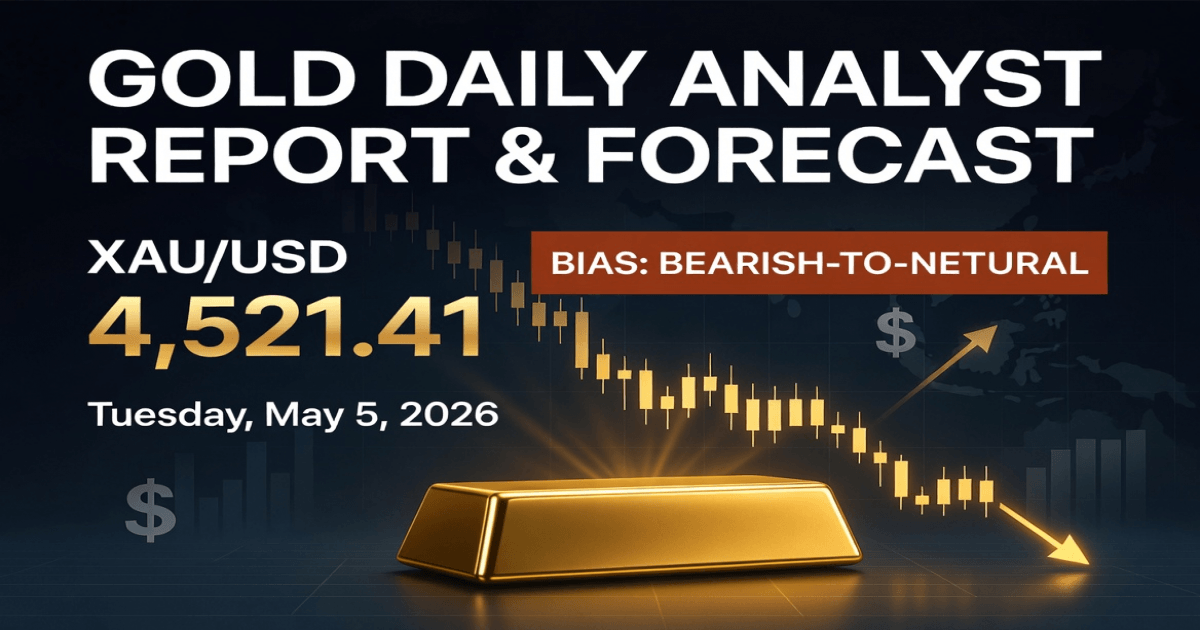
XAU/USD is currently trading at approximately 4,521.41, against a previous close of 4,523.88, with today's intraday range so far running from 4,518.35 to 4,524.68. The daily change is marginally negative (-2.47 / -0.05%), reflecting a consolidation off yesterday's sharper selloff. The net bias for today este Bearish-to-Neutral, driven by the following top drivers: (1) escalating US-Iran military tensions in the Strait of Hormuz, (2) a firmer US dollar and elevated Treasury yields pricing out Federal Reserve rate cuts, (3) the hawkish transition at the Fed as Kevin Warsh prepares to take the chair, (4) today's high-impact ISM Services PMI and JOLTS releases, and (5) persistent inflation pressure from oil above $100 per barrel capping gold's safe-haven appeal.
Key Market Developments (Last 24 Hours)
US-Iran Strait of Hormuz Escalation The US Navy began Trump's Operation Freedom to escort commercial shipping vessels through the Strait of Hormuz, after which Tehran retaliated by launching attacks against the UAE and deploying speedboats to halt vessel movement. CNN also revealed that the US and Israel could resume attacks on Iran within the next 24 hours. This escalation is paradoxically bearish for gold near-term because rising energy inflation reinforces the Fed's higher-for-longer stance, lifting the dollar and real yields even as geopolitical risk remains elevated.
Gold Tumbles to One-Month Lows Before Marginal Asian Recovery Gold fell more than 1% to approximately 4,580 on Monday, May 4, with intraday lows tagging 4,560, the metal's first sub-$4,580 print in more than five weeks, as a firmer dollar, rising Treasury yields, and the tanker strike in the Strait of Hormuz weighed on XAU/USD. Investing.com noted that gold prices ticked higher from these one-month lows in Asian trading on Tuesday as investors weighed escalating tensions. The recovery is tentative, suggesting a neutral-to-bearish setup heading into US session data releases.
Fed Rates Held, Powell Era Ends May 15 The Federal Reserve kept rates unchanged at 3.50-3.75% at Jerome Powell's final meeting as chair on April 29, with the decision nearly unanimous, though four total dissents marked the most internal division since October 1992. Three key Fed voters telegraphed that there is no convincing economic argument for easier monetary policy anytime soon, with energy prices remaining elevated due to the Iran war. This is bearish for gold, as rate cut expectations continue to erode.
Kevin Warsh Confirmation on Track, Hawkish Bias Priced In Warsh has warned that cutting rates while the economy is still adjusting to tariffs and elevated energy costs could repeat past policy mistakes, stating that once inflation takes hold it becomes more expensive to bring down. Markets are repricing for a Fed that may prefer a higher-for-longer approach under Warsh, who is set to take over on May 15. This introduces a sustained bearish headwind for non-yielding gold.
Oil Above $100, CPI Inflation at 3.3% Year-on-Year The dollar index is near 98.5 and March CPI inflation came in at 3.3% year-over-year, reducing Federal Reserve rate cut expectations and lifting Treasury yields. Elevated energy costs from the Hormuz disruption are feeding directly into inflation prints, keeping real yields firm and gold under pressure. Bearish.
WGC Reports Record Q1 2026 Central Bank Demand The World Gold Council reported that central banks added to their gold holdings at the fastest pace in more than a year during Q1 2026, with net central bank purchases hitting 244 tonnes in the quarter, up 3% year-on-year. This provides a structural floor but is insufficient to offset near-term macro headwinds. Neutral-to-mildly-bullish on the margin.
Economic Calendar Highlights – Today (May 5, 2026)
- 14:00 UTC – ISM Services PMI (April) The April Services PMI for the US is due for release today. Previous reading: 52.7 (March). A reading above 53.0 would signal ongoing services strength, reinforcing the no-cut narrative and pushing gold lower. A miss below 51.0 would reignite growth fears and could offer gold a brief safe-haven lift. High impact.
- 14:00 UTC – JOLTS Job Openings (March) JOLTS job openings data for March is also released today. A strong openings number confirms labor market resilience, reducing the Fed's urgency to cut and weighing on XAU/USD. High impact.
- Tomorrow, May 6 – RBA Rate Decision The Reserve Bank of Australia is having a monetary policy meeting this week and will deliver its decision on Tuesday, May 6. Market participants expect the Board to deliver a 25 basis point rate hike, the third consecutive one. A global tightening signal from the RBA could strengthen the dollar bloc and add modest pressure on gold heading into the next 24 hours. Moderate impact.
Analyst Outlook & Bias
Bias: Bearish-to-Neutral for the next 24-48 hours.
The structural case for gold remains intact via central bank demand and geopolitical risk, but the near-term tape is clearly under pressure. US 10-year Treasury yields have shown a consistent upward trend, moving above the 4.4% level, and while a slight pullback has been observed recently, the overall structure still reflects an environment of elevated and stable rates that continues to limit gold's upside potential.
On the technical side, immediate support is seen at the 100-hour SMA at approximately 4,623, and a break below this would expose the 23.6% Fibonacci level at 4,595, with the broader swing low at 4,505 coming into view on sustained weakness. The 38.2% Fibonacci retracement at 4,651 is the first meaningful resistance above the current price.
The dominant scenario for the week has gold chopping between 4,540 and 4,680, with rallies expected to be short-lived as long as 10-year Treasury yields remain above 4.30%.
Today's ISM Services PMI and JOLTS data are the key intraday catalysts. A beat on either print risks pushing XAU/USD back toward the 4,505 area. Any surprise softness in the data, or a sudden escalation in the Hormuz military situation that triggers a sharp dollar reversal, could produce a technical bounce toward 4,610-4,650. Traders should treat rallies as selling opportunities until gold reclaims the 50-EMA resistance at approximately 4,740 on a closing basis.