Market Sentiment
Primary Assets Affected
Table of Contents
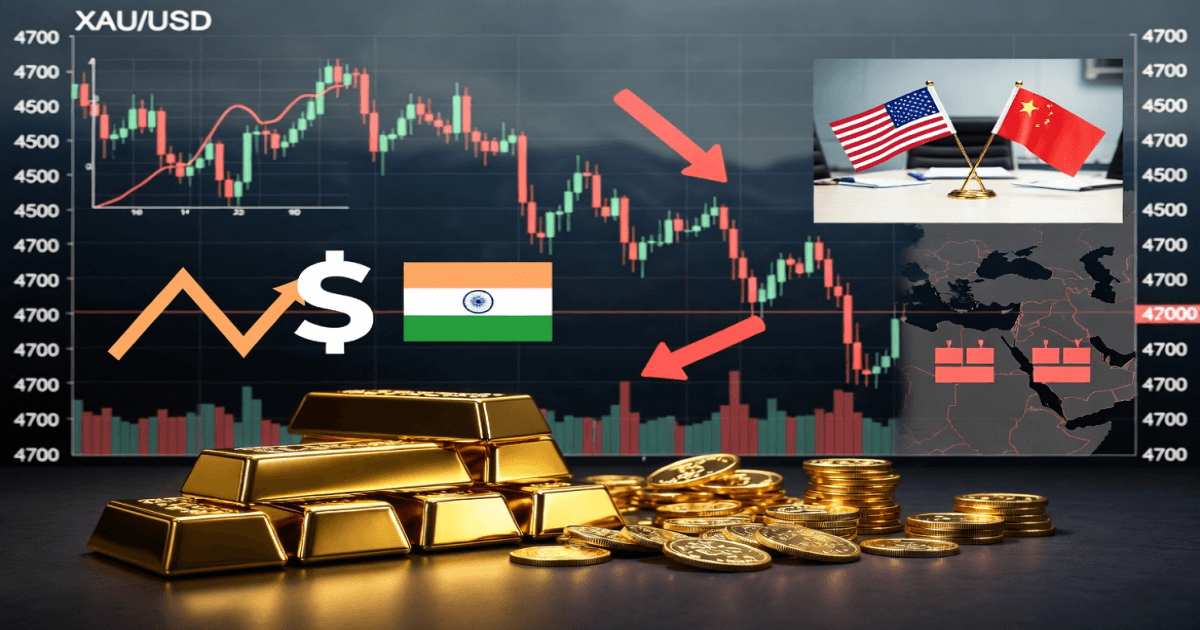
XAU/USD is currently trading at approximately 4,702.22, with today's range running from 4,668.81 to 4,717.18 and an opening print of 4,688.95, putting the daily change at roughly +13.27 (+0.28%). Bias is Neutral to mildly Bearish on an intraday basis. The top drivers are: a hot double inflation print (CPI + PPI) eliminating rate cut expectations, a firmer dollar, India's sharp gold tariff hike, the live Trump-Xi summit in Beijing, and today's batch of high-impact U.S. data releases.
Key Market Developments (Last 24 Hours)
- U.S. PPI April: Biggest jump since March 2022. The Producer Price Index for final demand rose 1.4% in April, the largest advance since March 2022, with the 12-month rate hitting 6.0% and final demand goods surging 2.0%. Coming on top of Tuesday's CPI beat, this has completed the case against any Fed rate cut in 2026. Bearish for gold via higher real yields and dollar strength.
- CPI April confirmed at 3.8%, highest since May 2023. U.S. consumer inflation accelerated to 3.8% in April, above market forecasts of 3.7%, driven by escalating energy costs tied to the Middle East conflict. The dual inflation shock has markets pricing out cuts entirely and debating hike odds. Bearish for the non-yielding metal.
- India doubles gold import tariff. India raised import tariffs on gold and silver to 15% from 6%, imposing a 10% basic customs duty alongside a 5% agriculture infrastructure levy, in a move to defend the rupee and shore up foreign exchange reserves strained by the Iran war. India is the world's second-largest gold consumer and meets nearly all of its domestic demand through imports. Near-term demand suppression from a 700-800 tonne annual buyer is a direct bearish factor.
- Trump-Xi summit underway in Beijing. Trump hailed talks as "extremely positive" and the two leaders are set to meet again Thursday. The Iran war and the Strait of Hormuz blockade were discussed, though the U.S. stated it is not asking for China's help with Iran. Beijing called for an urgent comprehensive ceasefire, saying negotiations remain of paramount importance. Any credible ceasefire signal would remove a key geopolitical premium from gold. Conditionally bearish.
- Fed speakers signal higher-for-longer, possibly hikes. Boston Fed's Susan Collins said rate hikes would be needed if inflation fails to approach the 2% target, adding she expects restrictive policy to persist. Minneapolis Fed's Neel Kashkari noted inflation is running too high due to the Iran war while the labor market looks solid. Both are hawkish and reinforce dollar strength.
Economic Calendar Highlights – Today (May 14, 2026)
- 08:30 UTC: U.S. Retail Sales (April) – Expected around +0.6%; prior +1.7% (March). A beat confirms consumer resilience, strengthens the dollar, and weighs on gold. A miss could provide modest relief.
- 08:30 UTC: Initial Jobless Claims (week ending May 9) – Consensus near 205,000. A robust labor market has persisted despite headlines about job cuts; a low print reinforces hawkish Fed expectations. Bearish for gold on a beat.
- 08:30 UTC: Core Retail Sales (April, ex-autos) – Watched for underlying consumer demand trends. High impact alongside the headline retail figure.
- Throughout the day: Fed speeches (Schmid, Hammack, Williams, Barr) – All scheduled in the context of fresh inflation data. Any explicit rate-hike reference will cap gold's upside decisively.
- Ongoing: Trump-Xi Day 2 talks in Beijing – Any joint statement touching on Iran or Hormuz will move gold immediately.
Analyst Outlook & Bias
Bias: Neutral to Bearish. Range: 4,650 to 4,720.
Gold is caught between two countervailing forces. The macro picture is clearly negative for the moment: back-to-back inflation beats, zero probability of a 2026 rate cut, a recovering dollar, and India removing itself as a reliable demand anchor. That combination would normally send gold decisively lower.
The problem is that the geopolitical floor remains intact. The Strait of Hormuz is still blocked, the Iran war has not ended, and the Trump-Xi summit has produced warmth but no resolution. Traders buying dips on safe-haven grounds have kept the metal from breaking below 4,650 despite the macro headwinds.
Technically, the 50-day and 100-day simple moving averages sit at 4,749 and 4,780 respectively, acting as firm overhead resistance. Price action is compressing into the 4,650 to 4,700 band. A strong Retail Sales print or hawkish Fed commentary this afternoon would test support at 4,650. A dovish surprise or data miss could push a short squeeze toward 4,720 to 4,749. The higher probability path over the next 24 to 48 hours is sideways-to-lower, with the key risk being any geopolitical headline out of Beijing or the Gulf that forces a fast repricing in either direction.