Table of Contents
XAU/USD is currently trading at 4,532.09, up about 38.4 dollars on the day (+0.85 percent) from a previous close near 4,493.69. The intraday bias is mildly bullish as gold stabilizes above 4,500 amid safe haven demand linked to the ongoing Iran war, softer risk sentiment, and a steady to slightly firmer US dollar. Key drivers over the next 24 hours are Middle East geopolitics, today’s US Fed communication (Powell and Williams), moves in US yields, and eurozone and German inflation data feeding into rate cut expectations.
Key Market Developments (Last 24 Hours)
-
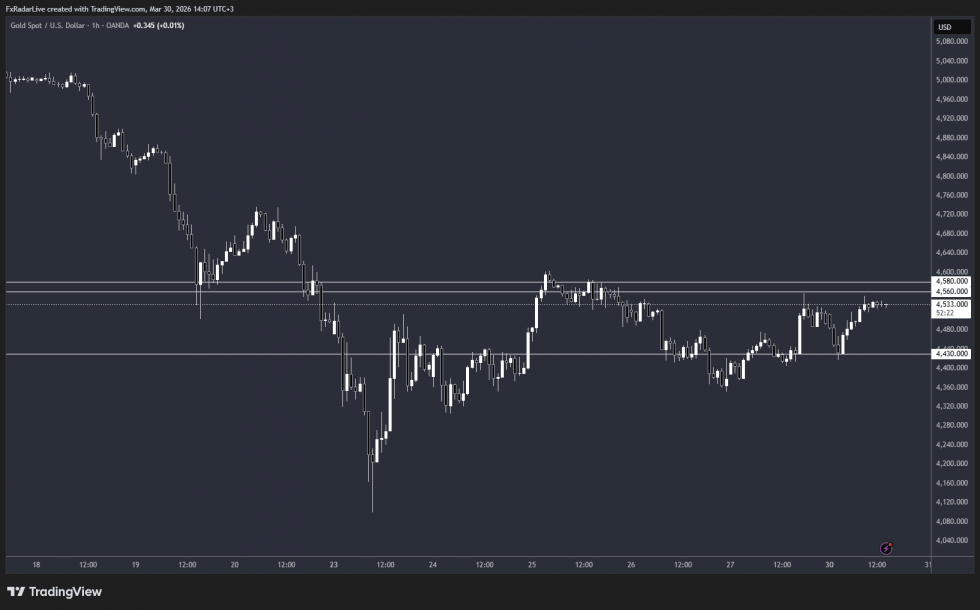
Gold is trading in a fresh range around 4,500 after an aggressive multi‑week selloff, with intraday gains today reflecting dip‑buying and short covering rather than a clean trend reversal (bullish but fragile).
-
News flow highlights that the Iran war has entered its second month, keeping a risk‑off undercurrent and supporting safe‑haven demand for gold despite recent volatility (bullish).
-
Equity markets remain under pressure, with major US indices recently sliding and volatility elevated, which tends to support gold on risk hedging flows (bullish).
-
Oil prices are heading for a record monthly rise, reinforcing stagflation concerns and helping medium‑term inflation hedging demand for gold, though higher real yields can partially offset this (mixed).
-
Trading signals on major platforms show daily technicals still skewed to “Strong Sell” on XAU/USD after the recent breakdown, which caps upside and encourages selling into strength intraday (bearish).
Economic Calendar Highlights – Today (UTC)
-
07:55–09:00: Germany regional CPI prints for March (various states). Previous readings were generally in the 1.8–2.3 percent YoY area; higher‑than‑expected inflation keeps ECB cautious and can weigh on gold via higher euro yields, while softer prints would be supportive (impact: mixed for gold).
-
08:45: France March inflation (CPI YoY prelim 0.9 percent vs 1.6 percent previous; HICP YoY prelim 1.1 percent vs 1.9 percent previous). Softer French inflation data point toward easing eurozone price pressures, which can support gold via lower expected real rates in Europe (bullish).
-
11:00: Euro area sentiment and confidence indicators (Economic Sentiment, Industrial and Services Sentiment, Consumer Confidence final). Weak sentiment would underscore growth concerns and support safe‑haven demand for gold (bullish).
-
14:00 (approx., 12:00–14:30 UTC window): Germany national CPI (March prelim, YoY and MoM, including HICP). A downside surprise would reinforce the disinflation story and support gold through lower Bund yields; upside surprise would be mildly negative for gold (mixed).
-
14:30 UTC (approx. 16:30 local US East): US Dallas Fed Manufacturing index (expected around 0.2) plus Fed Chair Powell’s speech later in the US session; any hint that the Fed might stay restrictive for longer would support the dollar and cap gold, while a more cautious tone on growth would help gold (key, potentially bearish or bullish).
-
15:30–19:30 UTC: US 3‑ and 6‑month bill auctions and Powell/Williams Fed speeches. Higher bill yields and a hawkish tone would pressure gold via higher real yields and a stronger dollar (bearish).
Analyst Outlook & Bias (Next 24–48 Hours)
For the next 24 hours, my bias is cautiously bullish but range‑bound, with gold likely to trade roughly between 4,450 and 4,580 as the market digests Fed communication and incoming European inflation data. Immediate resistance sits near today’s high around 4,550–4,560, followed by 4,600 and then 4,670, where recent upside attempts have stalled; on the downside, first support lies around 4,420–4,430, with stronger demand expected near 4,350–4,300 if risk sentiment deteriorates again.
Into the US session, a hawkish‑leaning Powell or a sharp back‑up in front‑end US yields would likely cap gold under 4,560 and could pull prices back toward 4,450, shifting the tone back to neutral or mildly bearish. Conversely, any dovish nuance or renewed escalation headlines out of the Iran conflict could trigger another spike in safe‑haven buying, opening a test of 4,580–4,600 in thin liquidity conditions. Overall, for intraday traders I favor buying dips toward the 4,430–4,450 area with tight downside risk, targeting 4,560–4,580, while respecting that daily trend indicators still argue against aggressively chasing upside breakouts at this stage.