Market Sentiment
Primary Assets Affected
Table of Contents
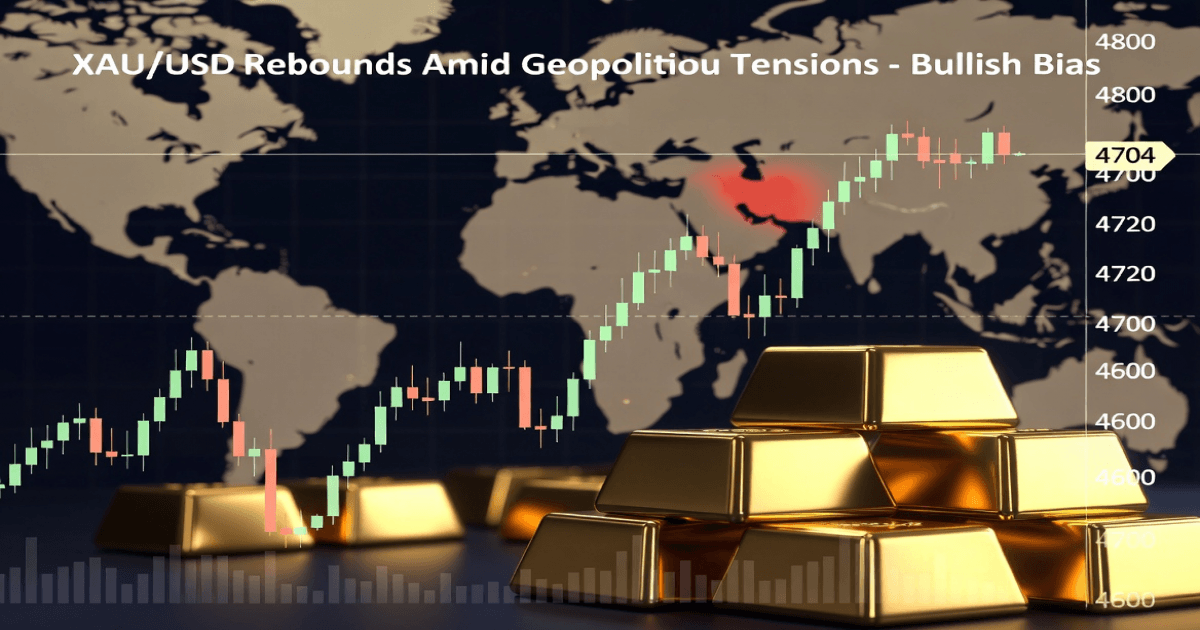
XAU/USD is currently trading at 4,657.45, up 6.89 on the day (+0.15%). The intraday bias is mildly bullish, with price holding near the upper half of today’s range after an earlier dip toward 4,617 and a rebound toward 4,694. Key drivers over the next 24 hours are softening US dollar conditions, slightly weaker US durable goods data, ongoing geopolitical tension around the Strait of Hormuz, persistent central-bank gold demand headlines and today’s US data/speaker slate that can shift Fed expectations.
Key Market Developments (Last 24 Hours)
-
Gold trades in a relatively tight but elevated range, with today’s low near 4,616.92 and high near 4,694.41, signaling ongoing dip-buying interest after a roughly 10% pullback over the past month but still very strong 1-year performance. This is modestly bullish for gold in the very near term as buyers defend support.
-
US dollar index is slightly softer on the day, with risk sentiment cautious ahead of US data and Fed speeches. A softer dollar is typically bullish for gold as it reduces the currency headwind for non-US buyers.
-
US February durable goods headline printed weaker than consensus at about −1.4% vs −1.1% expected, while core orders improved, painting a mixed picture of US cyclical momentum. Weaker headline data marginally supports gold via softer growth expectations, though the effect is moderate.
-
Market focus is elevated on President Trump’s looming Strait of Hormuz and Iran-related deadlines, which analysts describe as a “binary risk” scenario for markets. This geopolitical uncertainty is modestly bullish for gold as a hedge against potential escalation.
-
Commentary highlights that China’s multi‑month central‑bank gold buying spree remains a structural theme, underlining official-sector demand for bullion. While not a new flow today, the narrative continues to underpin dips in gold, offering a supportive background bid.
Economic Calendar Highlights – Today (UTC)
-
12:15 UTC – US ADP Employment Change (weekly proxy): actual 26.0K vs 15.25K expected. Stronger private employment is typically bearish for gold as it supports the case for the Fed to stay cautious on easing.
-
12:30 UTC – US Core Durable Goods Orders (MoM, Feb): actual 0.8% vs 0.5% expected, previous 0.3%. Strong core investment data is modestly bearish for gold via higher real-yield expectations.
-
12:30 UTC – US Durable Goods Orders (MoM, Feb): actual −1.4% vs −1.1% expected, previous −0.5%. The weaker headline tempers the hawkish read and is mildly bullish for gold through growth concerns.
-
14:00 UTC – US Atlanta Fed GDPNow (Q1): unchanged at 1.6%. Neutral for gold, as it signals steady but not overheating growth.
-
15:10 UTC – US IBD/TIPP Economic Optimism (Apr): actual 48.1 vs 47.5 expected. Slightly stronger sentiment is marginally bearish for gold, though the impact is typically limited.
-
21:50 UTC – Fed Governor Jefferson speaks. Any hints on the timing and pace of rate cuts could move real yields and the dollar, making this event potentially high impact for gold in late US/early Asia trade.
Analyst Outlook & Bias (Next 24–48 Hours)
Short-term bias for gold over the next 24 hours is cautiously bullish, with a buy‑on‑dips approach favored as long as intraday support holds. Today’s price structure shows buyers stepping in below 4,620 against resistance just under 4,700, suggesting a consolidation with a slight topside tilt.
Key intraday support is seen around 4,620/4,610 (today’s low cluster), followed by 4,580 and then the 4,520/4,500 zone if a deeper correction unfolds. Immediate resistance is located near 4,695/4,700, with a break opening room toward 4,740 and then 4,780. From a macro perspective, a mildly softer dollar, mixed but not aggressively strong US data and elevated geopolitical tension collectively argue for resilient demand into dips, while strong US data surprises or hawkish Fed rhetoric from Jefferson would be the main near-term bearish catalysts. Traders should monitor price behavior around 4,620 on the downside and 4,700 on the upside as pivot levels for the next 24 hours.