Market Sentiment
Primary Assets Affected
Table of Contents
- What Is a Trading Journal?
- Why Most Traders Fail Without a Trading Journal
- The Hidden Cost of Not Tracking Your Trades
- What Should a Good Trading Journal Include?
- Trade History
- Trade Review Pages
- Performance Analytics
- Equity Curve Tracking
- Setup Tracking
- Trading Calendar
- How a Trading Journal Improves Trading Performance
- Forex Trading Journal
- Gold Trading Journal
- Crypto Trading Journal
- Prop Firm Trading Journal
- Using Performance Analytics to Find Your Edge
- Why Equity Curves Matter
- Frequently Asked Questions
- What is the best free trading journal?
- Do professional traders use trading journals?
- Can I use a trading journal for Forex, Gold, Crypto, and Futures?
- How often should I review my trading journal?
- Is a trading journal useful for prop firm challenges?
- Free Trading Journal by FX Radar
Most traders spend countless hours searching for better entries, new indicators, and improved strategies.
Very few spend the same amount of time analyzing their own trading behavior.
That is one of the main reasons why many traders struggle to achieve consistent results.
A trading journal is one of the simplest yet most powerful tools available to traders. Whether you trade Forex, Gold, Crypto, Futures, Stocks, or Prop Firm accounts, maintaining a detailed trading journal can help you identify mistakes, improve discipline, and build a repeatable trading process.
In this guide, we'll explain why trading journals matter, what features to look for, and how traders can use performance data to improve long-term results.
What Is a Trading Journal?
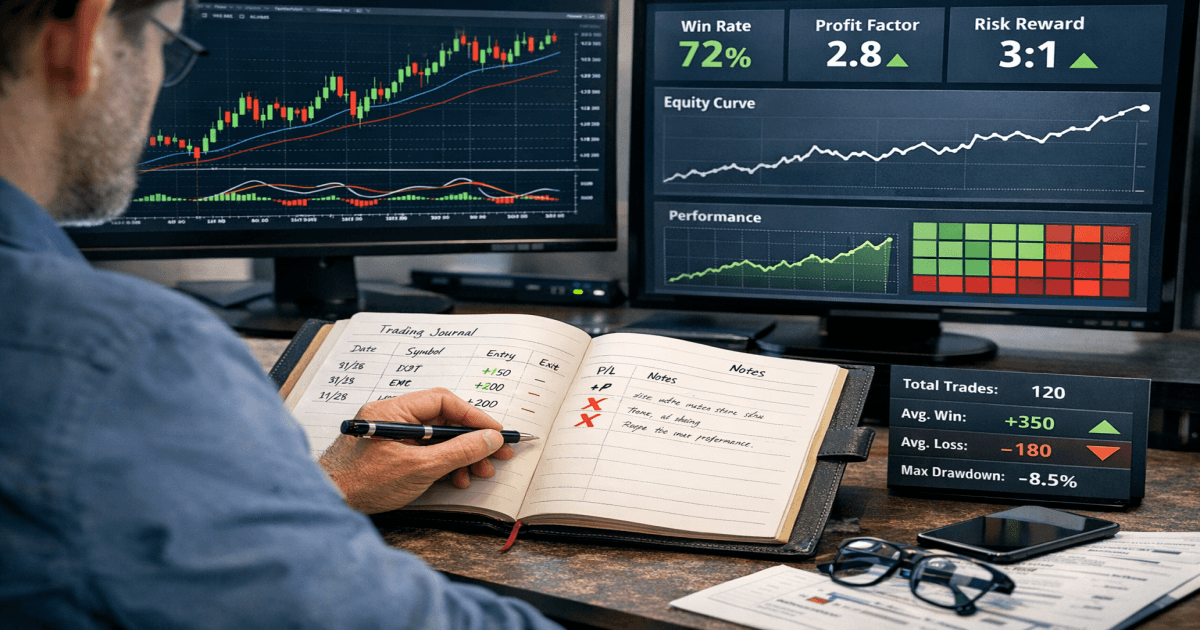
A trading journal is a structured record of your trading activity.
It allows traders to document:
- Entry and exit prices
- Trade direction
- Risk management decisions
- Strategy used
- Market conditions
- Trade screenshots
- Personal notes and reflections
- Trade outcomes
The purpose of a trading journal is not simply to record trades.
The real goal is to understand why trades succeed or fail and identify patterns that can improve future performance.
Why Most Traders Fail Without a Trading Journal
Many traders can answer questions like:
- What pair did I trade yesterday?
- How much did I make or lose?
Far fewer can answer:
- What is my most profitable setup?
- Which trading session produces my best results?
- What is my average risk-to-reward ratio?
- Do I perform better on longs or shorts?
- Which mistakes occur most often?
Without reliable data, traders are forced to rely on memory.
Unfortunately, memory is often selective and emotional.
A trading journal replaces opinions with facts.
The Hidden Cost of Not Tracking Your Trades
One of the biggest challenges in trading is identifying recurring mistakes.
Common examples include:
- Overtrading
- Revenge trading
- Moving stop losses
- Entering without confirmation
- Ignoring risk management rules
- Trading outside of a defined setup
Without proper tracking, these mistakes can continue for months before being recognized.
With a journal, they often become obvious after only a few reviews.
What Should a Good Trading Journal Include?
A professional trading journal should provide more than a simple list of trades.
The most useful journals include:
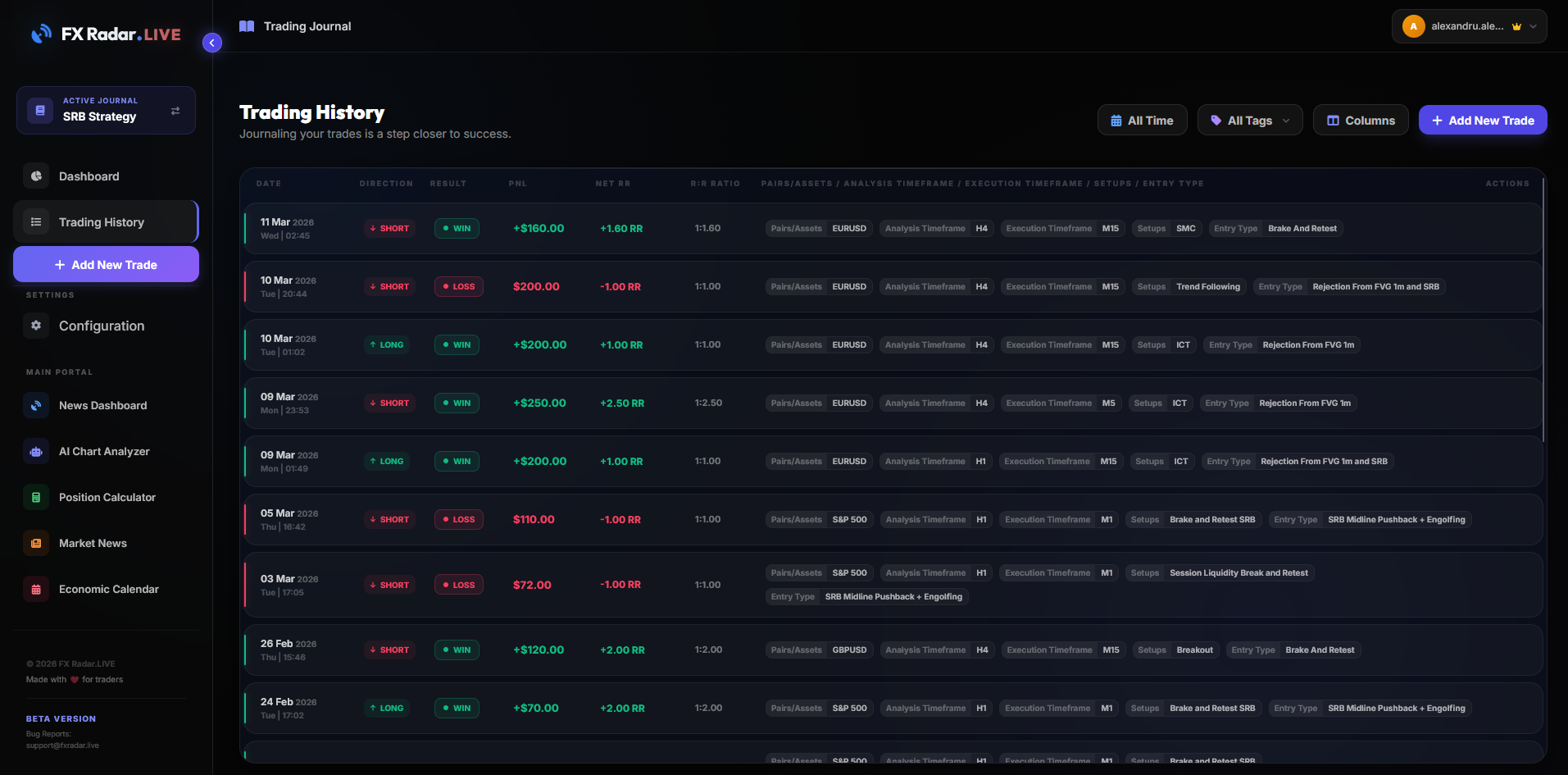
Trade History
A complete record of every trade taken.
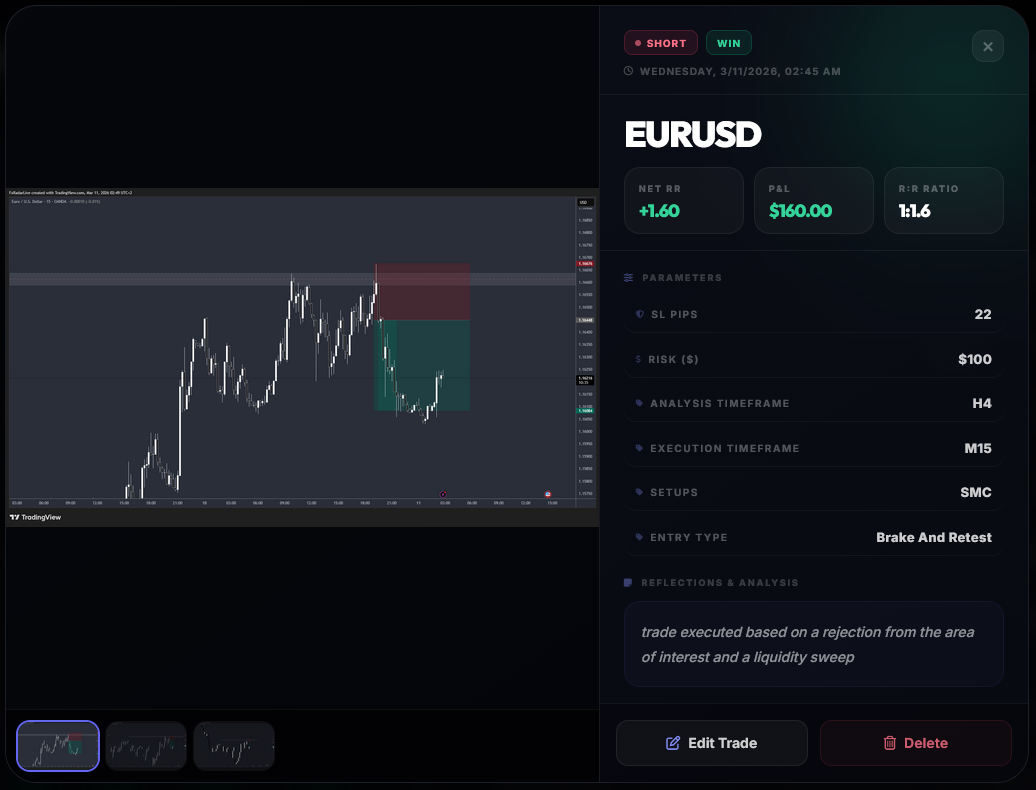
Trade Review Pages
Dedicated pages where traders can attach screenshots, explain reasoning, and review execution quality.
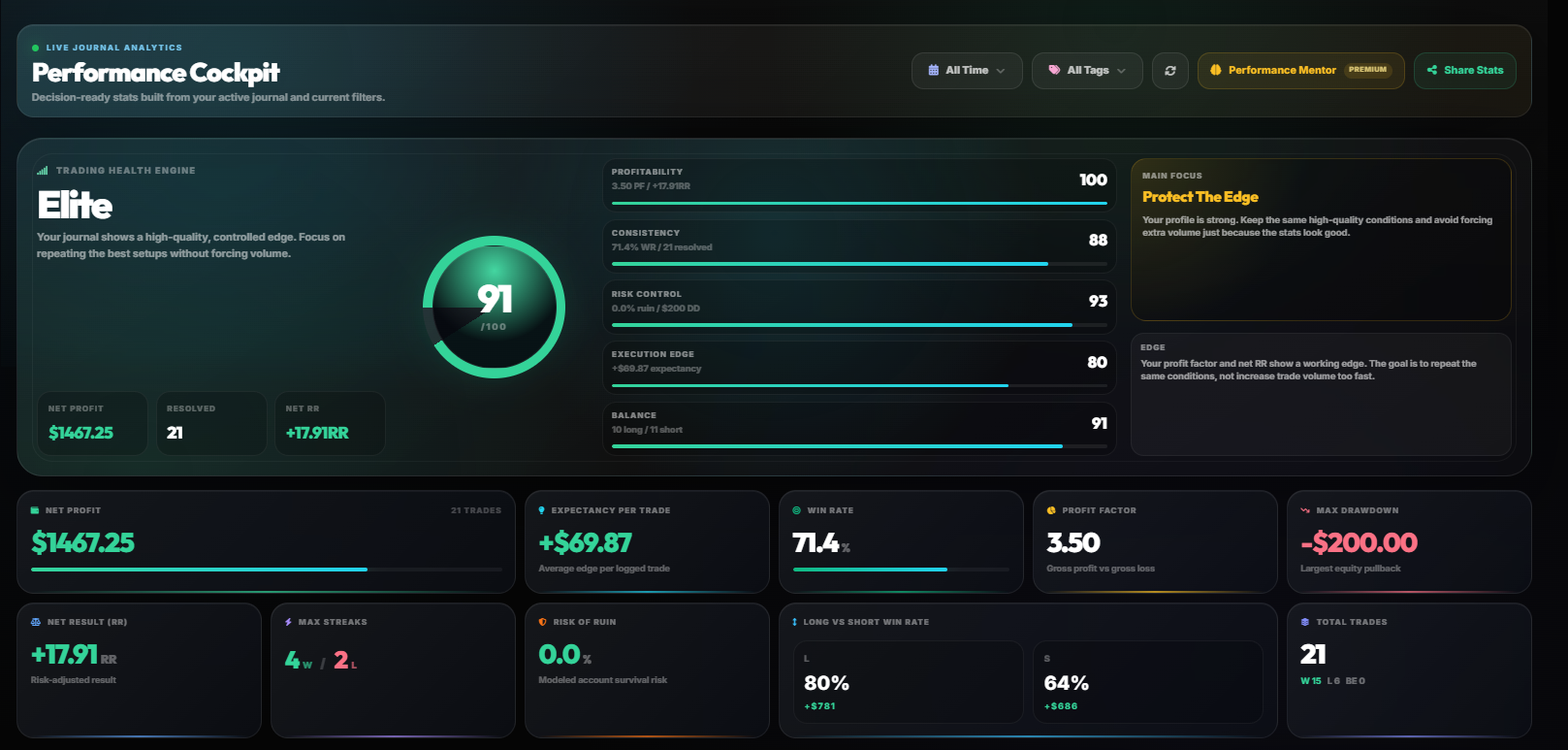
Performance Analytics
Metrics such as:
- Win Rate
- Profit Factor
- Expectancy
- Risk-to-Reward Ratio
- Drawdown
- Average Winner
- Average Loser
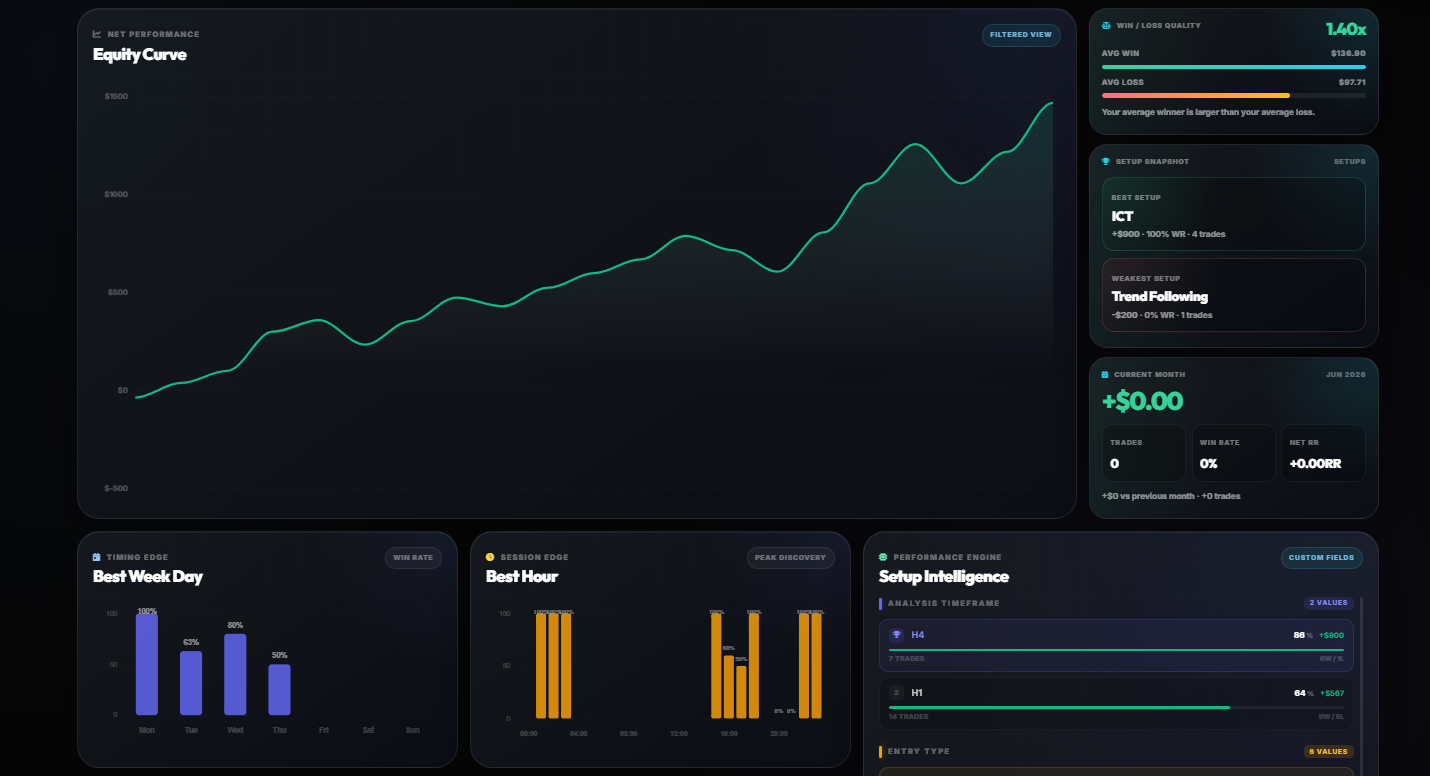
Equity Curve Tracking
A visual representation of trading performance over time.
Setup Tracking
The ability to compare different trading setups and identify which ones perform best.
Trading Calendar
A calendar view showing performance by day, week, and month.
How a Trading Journal Improves Trading Performance
A trading journal creates accountability.
When traders document every trade, they begin to notice patterns that are impossible to see otherwise.
For example:
A trader may discover that:
- 80% of profits come from only two setups.
- Most losses occur during low-liquidity sessions.
- Certain assets consistently outperform others.
- Trading frequency increases after losing trades.
These insights allow traders to focus on what works and eliminate what doesn't.
Over time, this often produces a greater impact than changing strategies.
Forex Trading Journal
Forex traders can use a trading journal to track:
- Currency pairs
- Trading sessions
- Risk-to-reward ratios
- Strategy performance
- Execution quality
Popular pairs such as EUR/USD, GBP/USD, USD/JPY, and AUD/USD can all be tracked and analyzed to identify long-term strengths and weaknesses.
Gold Trading Journal
Gold is one of the most actively traded markets in the world.
Due to its volatility, traders often benefit from recording:
- Market structure observations
- Entry confirmations
- Liquidity sweeps
- Risk management decisions
- Session timing
A dedicated gold trading journal helps traders remain objective during highly emotional market conditions.
Crypto Trading Journal
Cryptocurrency markets operate 24/7 and can produce significant price swings.
A crypto trading journal helps traders:
- Monitor risk exposure
- Track different trading setups
- Analyze performance across assets
- Identify emotional decision-making
Consistency becomes much easier when performance data is organized and accessible.
Prop Firm Trading Journal
For prop firm traders, journaling is often even more important.
Most evaluations include strict requirements such as:
- Maximum drawdown limits
- Daily drawdown restrictions
- Risk management rules
- Consistency requirements
Tracking performance through a prop firm trading journal allows traders to stay within evaluation rules while identifying opportunities for improvement.
Using Performance Analytics to Find Your Edge
Many traders focus exclusively on win rate.
However, profitability depends on much more than that.
Performance analytics can reveal:
- Profit Factor
- Expectancy Per Trade
- Average Winner vs Average Loser
- Best Trading Session
- Best Trading Day
- Best Setup
- Long vs Short Performance
These metrics provide a much deeper understanding of trading performance than win rate alone.
Why Equity Curves Matter
An equity curve provides a visual representation of trading performance over time.
A healthy equity curve can reveal:
- Consistent execution
- Controlled drawdowns
- Sustainable profitability
Meanwhile, unstable equity curves often highlight:
- Overtrading
- Poor risk management
- Inconsistent decision-making
Reviewing an equity curve regularly helps traders stay focused on long-term performance instead of individual trades.
Frequently Asked Questions
What is the best free trading journal?
The best trading journal is one that helps traders consistently track trades, review performance, and identify weaknesses through detailed analytics and trade reviews.
Do professional traders use trading journals?
Yes. Many professional traders use trading journals to monitor performance, analyze strategies, and maintain discipline.
Can I use a trading journal for Forex, Gold, Crypto, and Futures?
Yes. Modern trading journals are designed to support multiple asset classes and trading styles.
How often should I review my trading journal?
Most traders benefit from weekly and monthly reviews. Regular analysis helps identify recurring patterns and improve decision-making.
Is a trading journal useful for prop firm challenges?
Absolutely. Tracking drawdowns, consistency, and risk management can help traders stay within evaluation rules and improve their chances of success.
Free Trading Journal by FX Radar
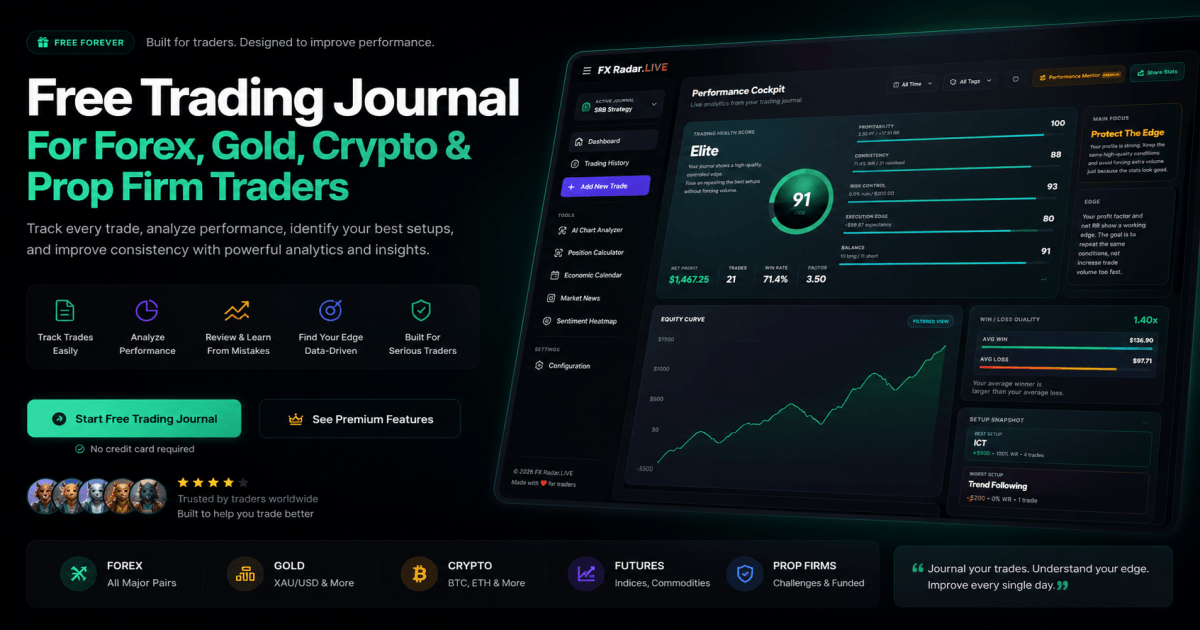
At FX Radar, we recently made our Trading Journal available for free.
The platform allows traders to:
- Track every trade
- Review individual executions
- Monitor performance metrics
- Analyze setups
- Visualize equity growth
- Maintain a complete trading history
Whether you're a Forex trader, Gold trader, Crypto trader, Futures trader, or Prop Firm trader, keeping a detailed journal can provide valuable insights into your performance.
Start using the free trading journal today:
https://www.fxradar.live/trading-journal
Because the traders who improve the fastest are usually the traders who measure everything.