Market Sentiment
Primary Assets Affected
Table of Contents
- Can ChatGPT analyze Forex charts?
- What Is an AI Forex Chart Analyzer?
- Can ChatGPT Analyze Forex Charts?
- Why Screenshot Analysis Has Limitations
- Why Live Market Data Is a Better Approach
- From AI Chart Analysis to AI Trade Planning
- AI Forex Signals vs AI Trade Planning
- Can AI Predict the Forex Market?
- ChatGPT vs AI Forex Chart Analyzer
- Where FX Radar Fits In
- Which One Should You Choose?
- Final Thoughts
Artificial intelligence is changing the way traders analyze financial markets. One of the most common questions today is:
Can ChatGPT analyze Forex charts?
The short answer is yes.
But can ChatGPT replace a dedicated AI Forex Chart Analyzer?
Not completely.
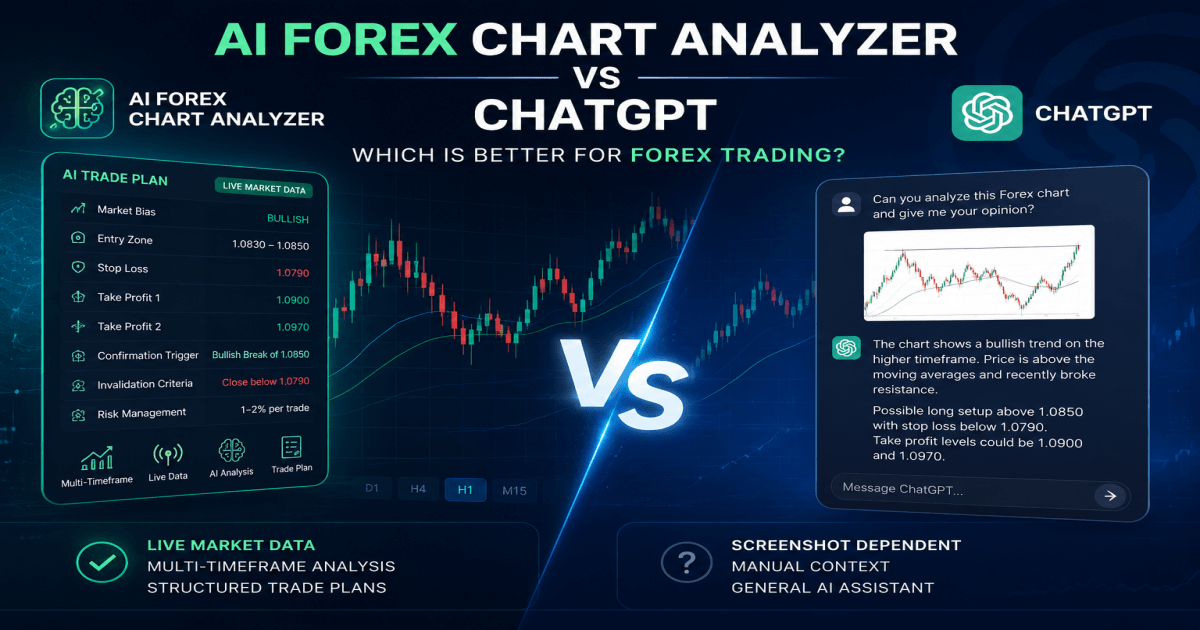
While both tools use artificial intelligence, they are built for different purposes. ChatGPT is an excellent general AI assistant capable of explaining trading concepts, reviewing screenshots, and discussing trading ideas. A dedicated AI Forex Chart Analyzer is specifically designed to analyze financial markets and generate structured trading plans.
If you're trying to decide which solution is better, this guide explains the differences.
What Is an AI Forex Chart Analyzer?
An AI Forex Chart Analyzer is a specialized trading tool that uses artificial intelligence to analyze market conditions and help traders make better trading decisions.
Instead of simply answering questions, these tools evaluate price action, market structure, trend direction, and multiple timeframes to generate structured trading plans.
A modern AI Forex Chart Analyzer can provide:
- Market Bias
- Entry Zone
- Stop Loss
- Take Profit Levels
- Multi-Timeframe Analysis
- Confirmation Triggers
- Invalidation Criteria
- Risk Management
Unlike general AI chatbots, these systems are built specifically around trading workflows.
Can ChatGPT Analyze Forex Charts?
Yes.
ChatGPT can analyze Forex charts when you upload a screenshot and provide enough context.
Many traders already use ChatGPT to ask questions such as:
- Is this market bullish or bearish?
- Where is the strongest support level?
- Does this trade setup look valid?
- Where should I place my stop loss?
- What would be a reasonable take profit?
For educational purposes, ChatGPT performs remarkably well. It understands candlestick patterns, market structure, support and resistance, technical indicators, and many popular trading strategies.
However, there is one important limitation.
ChatGPT only sees the screenshot you upload.
If the image is cropped, blurry, missing historical candles, overloaded with indicators, or simply lacks enough market context, the quality of the analysis naturally decreases.
Simply put:
The AI can only analyze the information it receives.
Why Screenshot Analysis Has Limitations
This limitation isn't unique to ChatGPT.
Almost every AI model working with screenshots faces the same challenge.
Every trader prepares charts differently.
Some screenshots include too many indicators.
Others hide the price scale.
Some are zoomed in too much.
Others don't include enough historical candles.
The AI first has to interpret the image before it can interpret the market itself.
That creates unnecessary complexity and often leads to inconsistent results.
Why Live Market Data Is a Better Approach
A new generation of AI trading platforms is moving away from screenshot analysis.
Instead of asking traders to upload images, these systems connect directly to structured live market data.
This creates a much cleaner workflow.
Rather than spending time preparing screenshots, the trader simply selects:
- The market
- The execution timeframe
The AI automatically performs multi-timeframe analysis, evaluates market structure, and generates a complete trading plan.
This is exactly the approach used by the new FX Radar AI Trade Planner.
👉 https://www.fxradar.live/forex-trade-planner-and-signals.html
From AI Chart Analysis to AI Trade Planning
Modern AI trading software is evolving beyond simple chart analysis.
Instead of only identifying bullish or bearish conditions, today's AI trading assistants generate complete trading plans.
A structured trade plan typically includes:
- Market Bias
- Entry Zone
- Stop Loss
- Take Profit 1
- Take Profit 2
- Confirmation Trigger
- Invalidation Criteria
- Trade Management
- Risk Context
Rather than providing a simple opinion, these systems provide a complete execution framework.
AI Forex Signals vs AI Trade Planning
Many traders search for AI Forex Signals.
Signals can certainly be useful because they provide quick trading ideas.
However, they usually answer only one question:
Should I buy or sell?
An AI Trade Planner goes much further.
Instead of simply suggesting a direction, it explains:
- Why the trade exists
- What confirms the setup
- What invalidates the idea
- How the trade should be managed
- When it's better not to trade
This approach encourages discipline rather than emotional decision-making.
Can AI Predict the Forex Market?
Probably not.
No artificial intelligence can consistently predict financial markets with complete certainty.
Forex prices are influenced by economic releases, central bank decisions, geopolitical events, liquidity, and trader psychology.
The purpose of AI should not be prediction.
Instead, AI helps traders:
- Organize market information
- Reduce emotional decisions
- Build structured trade plans
- Stay consistent
- Improve discipline
The best AI trading tools don't promise certainty.
They help traders make better-informed decisions.
ChatGPT vs AI Forex Chart Analyzer
| Feature | ChatGPT | AI Forex Chart Analyzer |
|---|---|---|
| Screenshot Analysis | ✅ | ✅ |
| Live Market Data | ❌ | ✅ |
| Automatic Multi-Timeframe Analysis | ❌ | ✅ |
| Entry Zone | Manual | ✅ |
| Stop Loss | Manual | ✅ |
| Take Profit Targets | Manual | ✅ |
| Confirmation Trigger | ❌ | ✅ |
| Invalidation Criteria | ❌ | ✅ |
| Interactive AI Chat | ✅ | ✅ |
| Built Specifically for Trading | ❌ | ✅ |
Where FX Radar Fits In
When FX Radar was first launched, it worked as an AI Forex Chart Analyzer that analyzed TradingView screenshots uploaded by traders.
You can still try the original version here:
https://www.fxradar.live/ai-forex-chart-analyzer
While the results were often very good, one limitation became obvious over time.
The AI wasn't the problem.
The screenshots were.
Different layouts, cropped charts, poor image quality, missing candles, and inconsistent timeframes all affected the quality of the analysis.
Instead of trying to improve screenshot recognition forever, we redesigned the entire workflow.
Today, FX Radar connects directly to live Forex and Gold market data, automatically performs multi-timeframe analysis, and generates complete AI trading plans without requiring traders to upload charts.
You can try the new AI Trade Planner here:
https://www.fxradar.live/forex-trade-planner-and-signals.html
Every generated plan includes:
- Market Bias
- Entry Zone
- Stop Loss
- Take Profit Levels
- Confirmation Trigger
- Invalidation Criteria
- Trade Management
- Risk Context
After the plan is generated, traders can continue chatting with Axel, our AI Trading Assistant, to ask questions such as:
- Why is this trade valid?
- What invalidates this setup?
- Should I wait for confirmation?
- Are there any fresh market news affecting this trade?
The goal isn't to build another AI signal generator.
The goal is to help traders develop more discipline through structured trade planning.
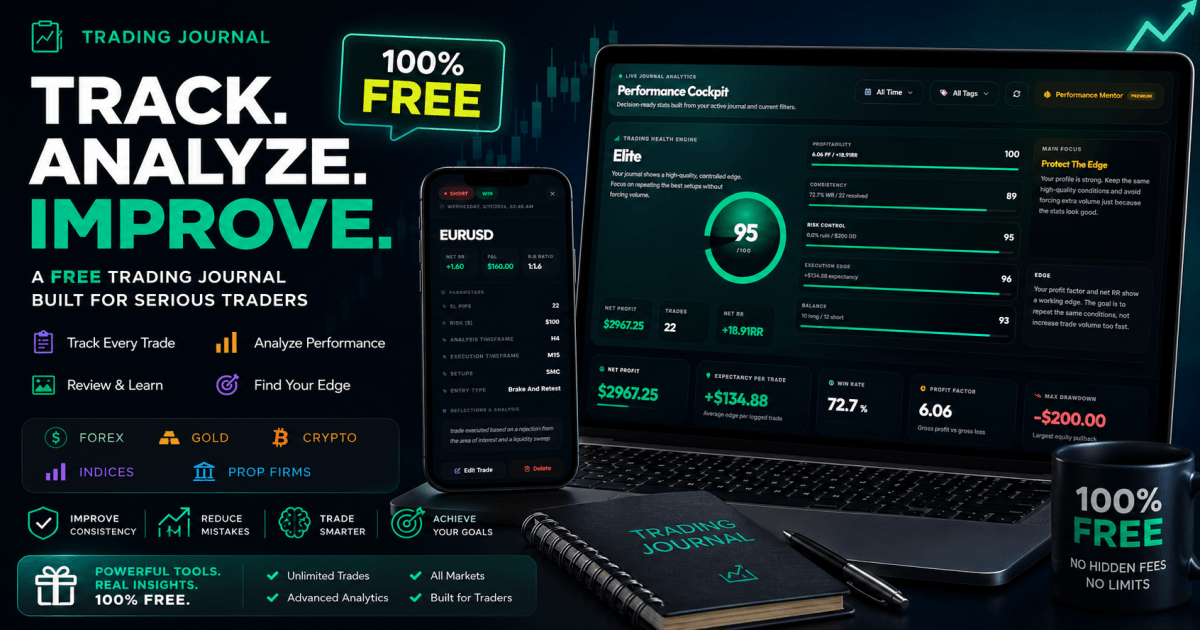
If you're also tracking your performance, you can use the free FX Radar Trading Journal:
Which One Should You Choose?
The answer depends on your workflow.
If you're learning technical analysis, discussing trading concepts, or reviewing occasional screenshots, ChatGPT is an outstanding assistant.
If you're looking for structured market analysis, automatic multi-timeframe context, and complete trading plans built around live market data, a dedicated AI Forex Chart Analyzer provides a much more specialized experience.
Many traders actually use both.
ChatGPT is excellent for education.
Dedicated AI trading platforms complement it by automating market analysis, execution planning, and risk management.