Market Sentiment
Primary Assets Affected
Table of Contents
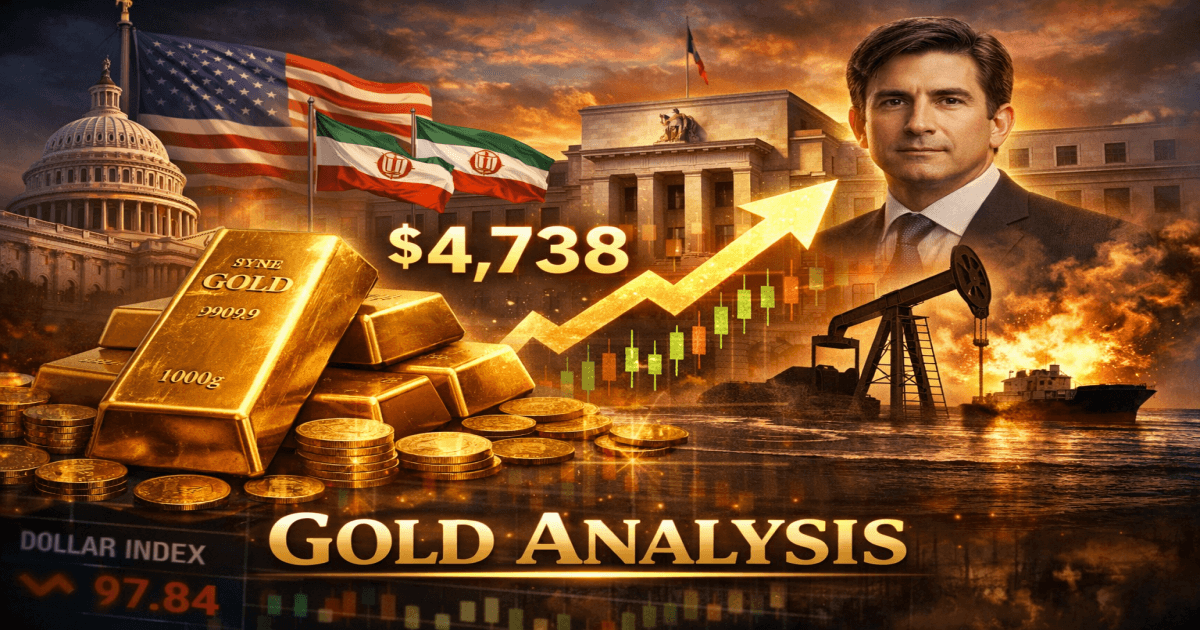
XAU/USD is currently trading at $4,738.21 (+$180.66 / +3.96% from the prior close of $4,557.55), holding near intraday highs heading into the European session. Bias is Cautiously Bullish, though gains remain fragile and headline-dependent. The top drivers are: a tentative U.S.-Iran peace memorandum compressing oil prices and easing inflation fears; a weaker dollar and falling Treasury yields; and the imminent Warsh Fed transition, which introduces a competing hawkish drag that keeps a ceiling on the rally.
Key Market Developments (Last 24 Hours)
- U.S.-Iran Peace Memorandum Talks Advance. Washington and Tehran are closing in on a one-page memorandum to end the war in the Gulf, according to a source from mediator Pakistan. The reports sent global oil prices plunging, with Brent falling toward $100 a barrel. Lower oil reduces inflation fears directly, reopening the door for Fed rate cuts later in 2026. Bullish for gold.
- Gold Rises for a Third Straight Session. The metal advanced for a third consecutive day Thursday, supported by a softer dollar as peace-deal optimism built. The consecutive-session run reflects growing momentum, but bulls remain hesitant to push cleanly through the $4,700-$4,715 resistance cluster. Mildly bullish.
- Dollar Weakens, Yields Compress. The U.S. Dollar Index slipped to the 97.84-97.99 zone, its lowest since early March. The 10-year Treasury yield compressed roughly 7 basis points to 4.353%. Falling real yields restore the negative correlation gold needs to extend higher. Bullish.
- Fed Transition: Warsh Clears Committee. The Senate Banking Committee voted 13-11 along party lines to advance Kevin Warsh's nomination as Fed Chair to a full Senate vote, with the earliest floor vote expected May 11. This marks Powell's final days as Chair, with his term ending May 15. Warsh has not committed to supporting future rate cuts, reinforcing expectations of a tighter policy stance ahead. Bearish on the margin.
- April ADP Jobs Beat. Private payrolls rose by 109,000 in April, the strongest gain since January 2025. That result weakens the case for near-term Fed easing by showing the labor market still has enough momentum to sustain demand-side inflation pressure. Bearish for gold; keeps the Fed on hold.
- Q1 2026 Gold Demand Hits Record $193 Billion. The World Gold Council reported total demand including OTC investment rose 2% year-on-year to 1,230.9 tonnes, with bar and coin demand up 42% to 474 tonnes, the second-highest quarterly figure on record. Asian investors were the primary drivers. Structural demand remains strong beneath the geopolitical noise. Bullish.
Economic Calendar Highlights – Today (May 7, 2026)
- 12:30 UTC: U.S. Initial Jobless Claims (week ending May 3). Previous reading in the low-200s range. A higher-than-expected print softens the rate-hold narrative and gives gold a modest lift. A miss does the opposite. Medium impact.
- All Day: Fed Speaker Watch. Any commentary on the pace of rate cuts or on policy continuity under the Warsh transition could move gold quickly. Hawkish tone: bearish. Any dovish lean: bullish. High impact given the leadership vacuum at the Fed right now.
- Tomorrow, May 8, 08:30 UTC: U.S. Nonfarm Payrolls and Unemployment Rate. The dominant event risk hanging over today's session. Markets are already positioning ahead of the print. Expect intraday gold volatility to build as the New York session progresses. High impact.
Analyst Outlook & Bias
Short-term bias: Cautiously Bullish. Headline-fragile.
The single cleanest summary of this market came from Zaner Metals strategist Peter Grant: the U.S.-Iran optimism has created short-term relief through lower oil, moderated inflation concerns, and recalibrated rate-cut expectations. The market will keep pivoting on Middle East headlines. That is exactly right.
Technically, gold has support at $4,580-$4,600 and faces its first meaningful resistance at the $4,700-$4,715 downtrend line. RSI momentum is shifting bullish on the hourly chart. A clean break above $4,715 opens the path to $4,882. On the downside, a break of $4,580 brings $4,500 into play quickly.
The two-sided risk is real and not symmetric. A confirmed peace deal would likely push oil below $90, crush inflation expectations, force rate-cut pricing back into the curve, and drive gold toward $4,882 resistance. If talks collapse or Iran rejects the memorandum terms, oil spikes, inflation fears return, and gold pulls back hard.
The Warsh confirmation timeline adds a hawkish overhang that does not resolve this week. Friday's NFP is the more immediate catalyst. For today, the path of least resistance is modestly higher while peace-deal headlines hold. The risk-reward is narrow. Do not chase extended levels into tomorrow's jobs data.